İnan Seramik · Technology
Silicate chemistry
Çini, the plate on the table and the glaze on top of it are all silicate chemistry: the network silicon and oxygen build, the fluxes that enter it, and how the network is fired. This page explains the chemistry of what we do every day in the workshop, through an engineer's eyes, in plain words.
The network: silicon and oxygen
The brick of silicate glass is the SiO₄ tetrahedron: one silicon in the middle, four oxygens at the corners. Tetrahedra share corners and build a continuous but disordered network; it differs from a crystal only in not being periodic. In 1932 Zachariasen set four rules for which oxides can form a glass alone; SiO₂ and B₂O₃ satisfy them.
When fluxes (Na₂O, K₂O, CaO, MgO, Li₂O) enter the network, non-bridging oxygens form; the network loosens, melting point and viscosity fall. Intermediates such as Al₂O₃, ZnO, PbO and TiO₂ do not form glass alone but join the network when formers are present; alumina stiffens a glaze and stops it running.
- Network former
- SiO₂, B₂O₃
- Intermediate
- Al₂O₃, ZnO, PbO, TiO₂
- Flux (modifier)
- Na₂O, K₂O, CaO, MgO, Li₂O
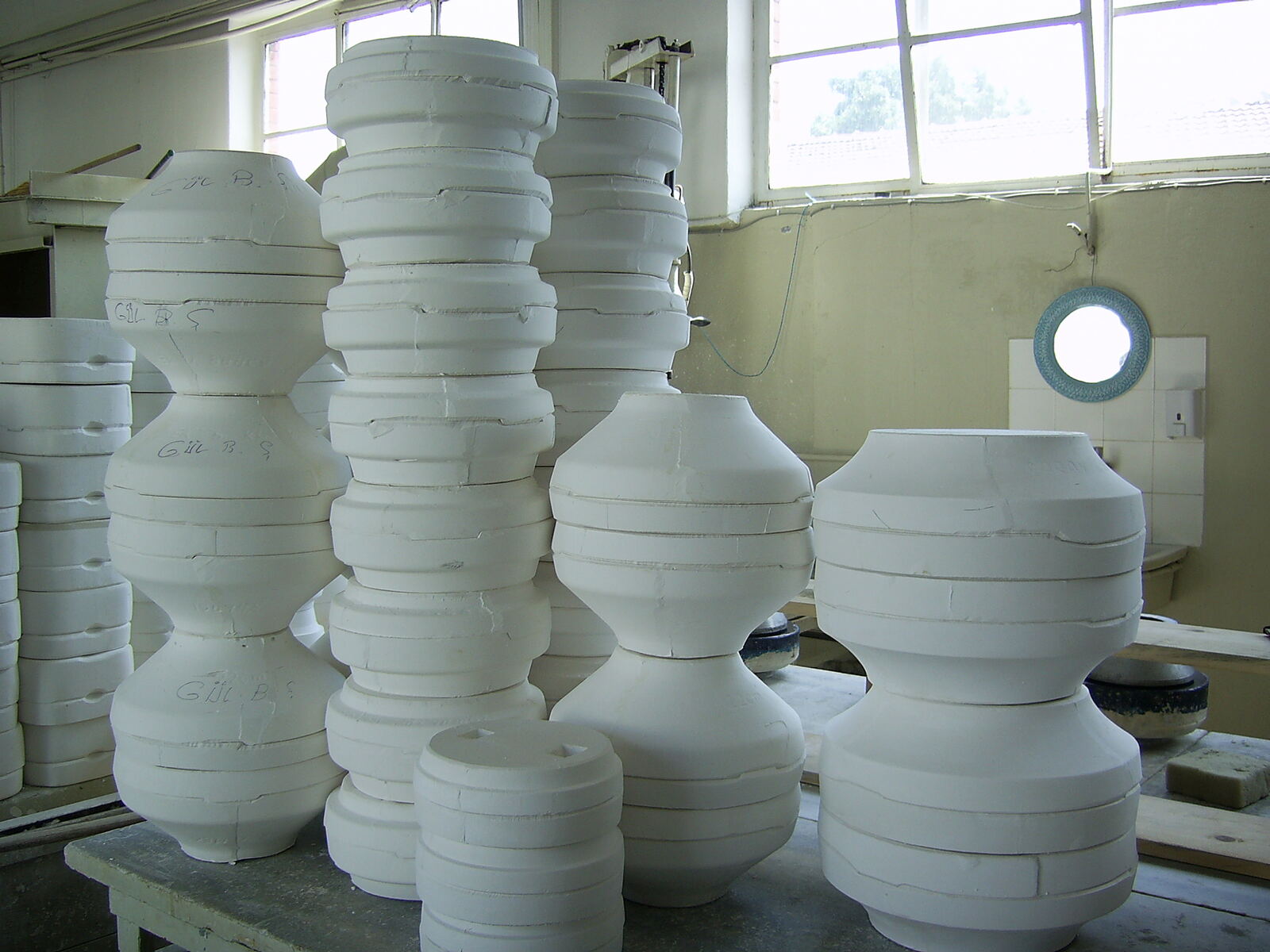
The body: clay, quartz, feldspar
A body is built from two kinds of raw material: plastic ones (clay, kaolin) give workability and green strength; non-plastic ones (quartz, feldspar, calcite, dolomite) build the skeleton and flux it. The Kütahya çini body is quartz-rich: by the geographical indication file, SiO₂ 65–80 %, Al₂O₃ 13–17 %.
Water absorption is the simplest measure of how far a body has vitrified. A çini body absorbs 20–25 % after biscuit and is 30–35 % porous; stoneware comes down to 1–3 %, porcelain to about zero. Porosity is good for underglaze colour and bad for the table: a pinhole or a crazed glaze lets liquid into the body.
- Çini body SiO₂
- 65–80 %
- Çini water absorption
- 20–25 %
- Stoneware absorption
- 1–3 %
- Porcelain
- ≈0 %
What happens in the kiln
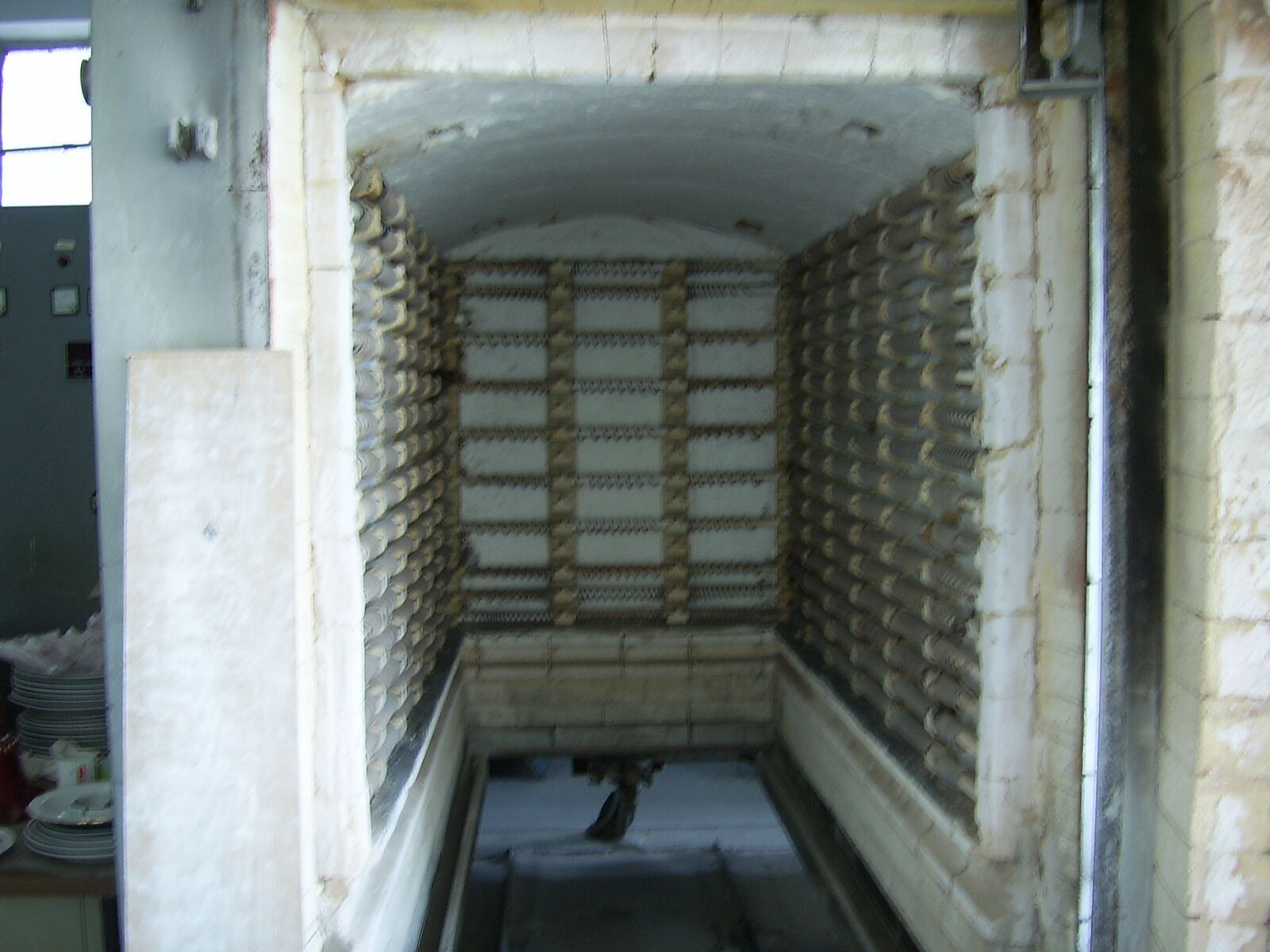
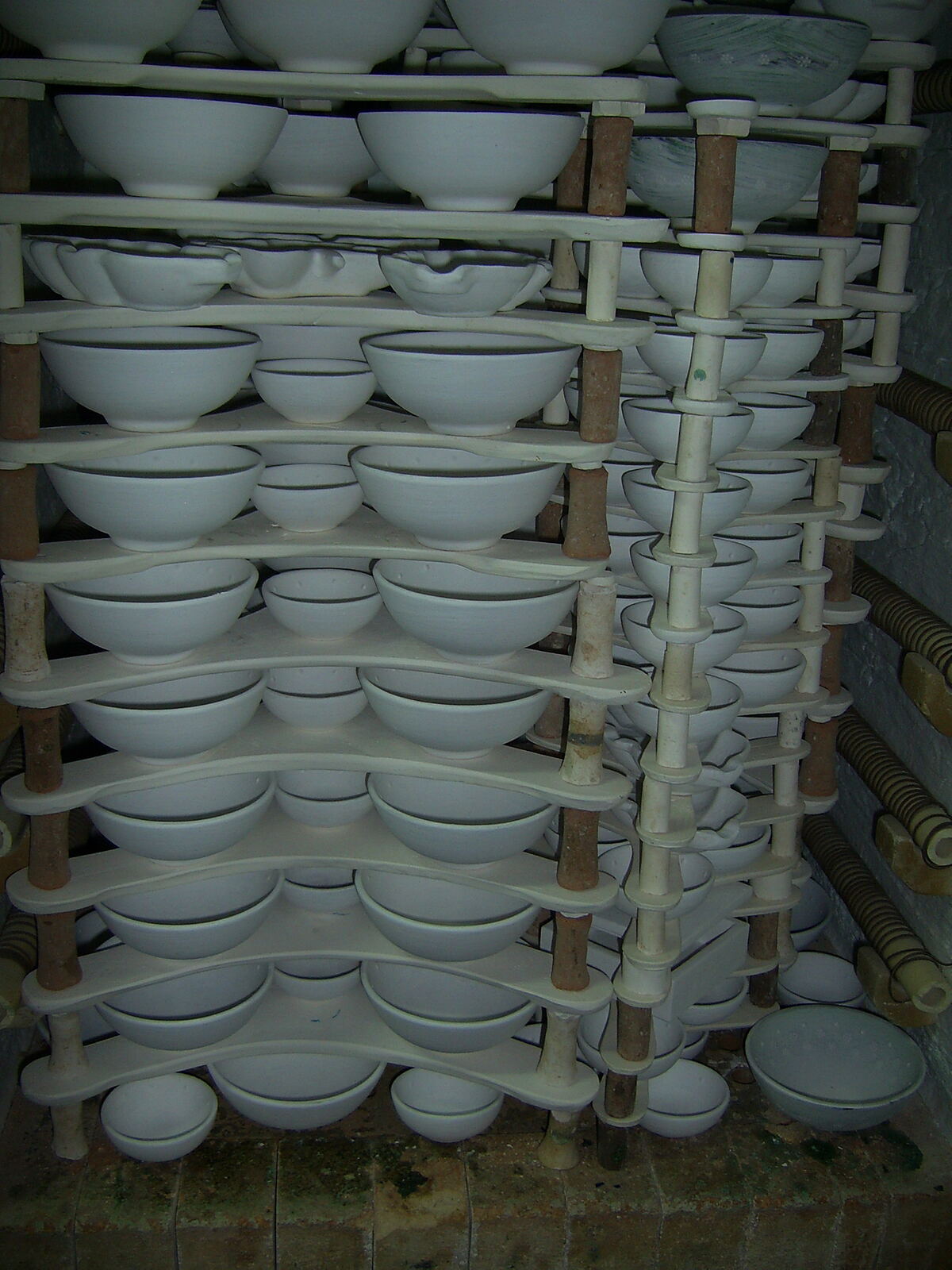
As the kiln rises the body passes several critical thresholds. Between 100 and 200 °C the remaining water leaves; a damp piece is burst by its own steam. Between 450 and 600 °C kaolinite loses its bound water and becomes metakaolin. At 573 °C quartz changes from α to β and grows 0.45 %; passing this point fast, above all on cooling, cracks the body. Between 600 and 1000 °C organic matter burns out; go fast and a black core remains. Around 980 °C metakaolin gives spinel, then mullite needles grow; the fluxes form a glassy phase that binds the grains.
There is one more threshold on cooling: the cristobalite inversion around 220 °C, a sudden 0.8 % contraction. Quartz and cristobalite put the glaze under compression with these contractions; at the right level this protects the glaze, in excess it makes it shiver.
- Bound water leaves
- 450–600 °C
- Quartz α→β
- 573 °C, 0.45 %
- Organic burnout
- 600–1000 °C, slow
- Spinel → mullite
- ≈980 °C and above
- Cristobalite (cooling)
- ≈220 °C, 0.8 %
Glaze: a thin glass
A glaze is a thin silicate glass formed on the body during firing. Its recipe is written as a Seger formula: fluxes (RO and R₂O), alumina (R₂O₃) and glass formers (RO₂) in molar ratios. That formula is the language for comparing one glaze with another, and a glaze with a body.
A frit is glass that has been melted, quenched in water and ground. Why? Boron and soda dissolve in water; a frit makes them insoluble. Lead and barium are toxic; a frit binds them into glass. The gases of the raw materials leave during fritting, so fewer pinholes remain. And a frit melts low and gradually. The traditional Kütahya çini glaze is lead-boron based (geographical indication: PbO 30–40 %, B₂O₃ 8–13 %); that is why çini is decorative. Lead-free boron, zinc and bismuth frits give a bright, clear glaze at the same temperature.
- Çini glaze (GI file)
- PbO 30–40 %, B₂O₃ 8–13 %
- Lead-free route
- Boron, zinc, bismuth frits
- Why frit
- Solubility, toxicity, gas, melting
Glaze–body fit
If glaze and body do not shrink at the same rate on cooling, stress builds up. If the glaze shrinks more than the body it stays in tension and cracks in a net: crazing. If it shrinks less, the body squeezes it and flakes lift at the edges: shivering. The ideal is a glaze under slight compression; a little compression adds strength, too much breaks a thin piece.
Most crazing is solved by adjusting the thermal expansion of the glaze: lowering the alkali share (Na₂O, K₂O), balancing boron and alumina. Playing with glaze thickness or firing is a sticking plaster. In our workshop glaze fit is checked with an ice-water test and test tiles.
- Crazing
- Glaze expansion too high
- Shivering
- Glaze expansion too low
- Ideal
- Glaze under slight compression
- Adjustment
- Alkali down, balance with boron and alumina
Opaque glazes
What turns a clear glaze white is small particles and crystals that scatter light. Industry's opacifier is zirconium silicate: about 10 % of the glaze, ground below 5 microns. Tin oxide is whiter but expensive; 5–10 % is needed. Titania opacifies at 5–6 % and may turn yellowish. Talc above 20 % gives a hard, matte white glaze.
Too much boron gives a haze called boron bloom; raising alumina removes it. Opacity drops with overfiring and thin coats; zircon disperses best inside a frit. These come from our own seminar notes on reducing zircon in opaque glazes.
- Zircon
- ≈10 %, <5 µm
- Tin oxide
- 5–10 %, whiter
- Titania
- 5–6 %
- Talc
- >20 %, matte white
Colour: oxides and stains
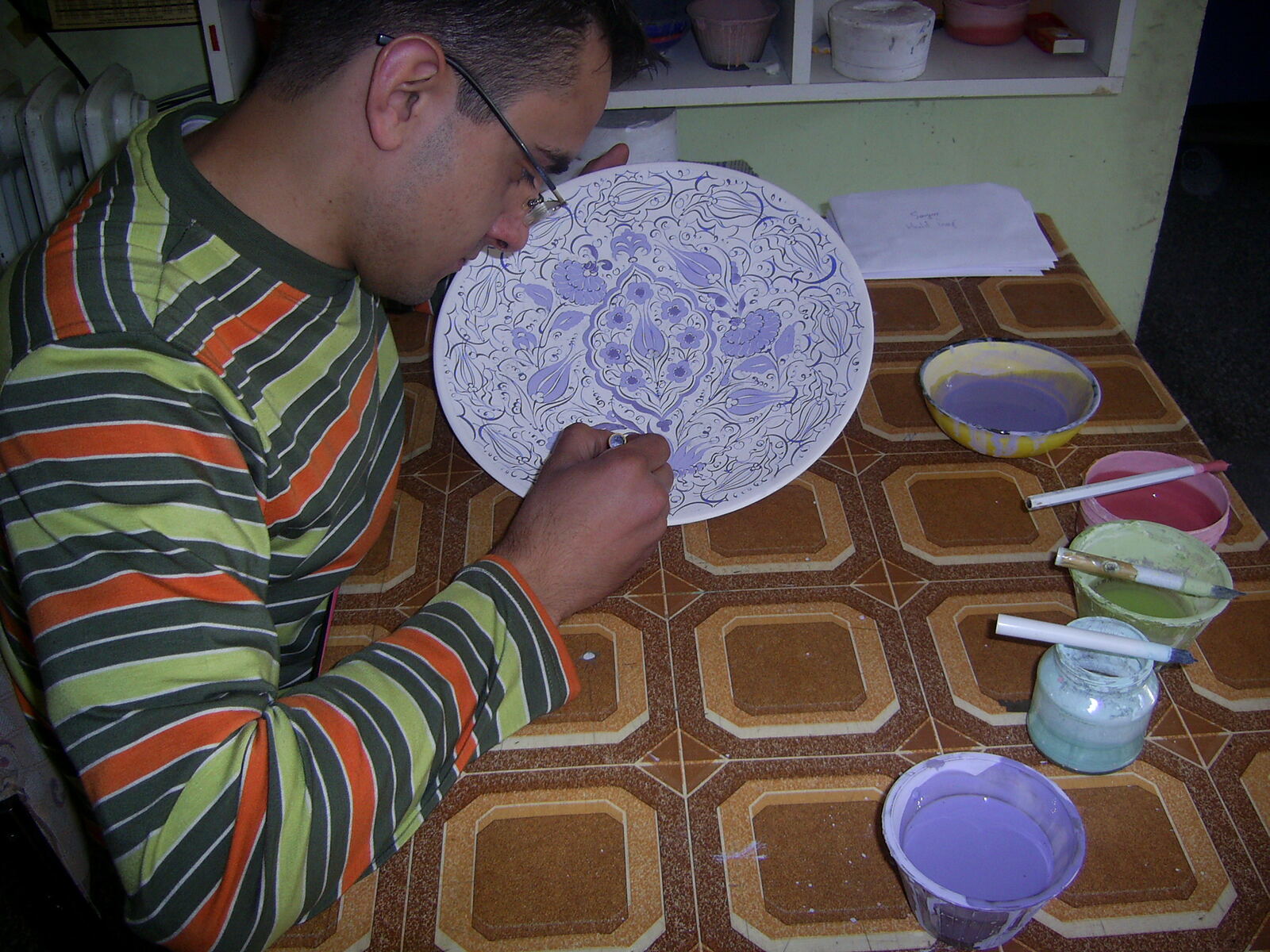
Underglaze colours come from metal oxides: cobalt for dark blue (the old name süleymani), copper for turquoise, chromium for green, manganese for purple, chromite for black (müzerret), iron for brown and brick red. These colours must survive the glaze temperature; cobalt, chromium and iron go above 1000 °C with ease.
Bright red and orange come from encapsulated stains, cadmium-selenium locked inside a zircon crystal; stable to 1220 °C, and a leach test is mandatory on a food surface. On-glaze colours are fixed in a third firing at 600–890 °C: the widest palette, the lowest durability.
- Cobalt
- Dark blue
- Copper
- Turquoise, green
- Chromium
- Green
- Manganese
- Purple
- Chromite
- Black
- Iron
- Brown, red
Tableware and safety
Ceramics in contact with food are governed in Türkiye by the Turkish Food Codex Communiqué 2012/30: in fillable vessels lead at most 4.0 mg/L and cadmium 0.3 mg/L; on flat surfaces 0.8 and 0.07 mg/dm². The test is 4 % acetic acid at 22 °C for 24 hours, and the seller issues a written declaration of conformity. Limits are tightening in Europe: the Netherlands cut lead to 30 µg/L in 2026.
The traditional lead çini glaze is far above these limits (geographical indication file: 20–30 mg/dm²); that is why çini is decorative, not tableware. Tableware needs a lead-free glaze, underglaze or in-glaze decoration, and a release test. Dishwasher resistance is measured by EN 12875; in-glaze decoration survives, on-glaze decoration wears in alkali.
- Lead, fillable vessel
- ≤ 4.0 mg/L
- Cadmium
- ≤ 0.3 mg/L
- Test
- 4 % acetic acid, 22 °C, 24 h
- Çini lead release
- 20–30 mg/dm² → decorative
Technical notes
From the workshop's own seminar and laboratory notes: casting, drying, firing and dust.
Casting slip
Most casting faults come from a low litre weight: the mould gets wet, the piece releases late, shrinks too much and cracks.
In a deflocculated slip the litre weight is 1700–1800 g/L and the deflocculant 0.2–0.5 % of dry matter. Excess deflocculant sticks the piece to the mould and leaves brown stains (lignin) on the plaster; the cure is water and clay, not vinegar.
Casting rate goes with the square of thickness: double the wall and the time quadruples. Warm slip casts faster.
- Litre weight
- 1700–1800 g/L
- Deflocculant
- 0.2–0.5 %
- Particle size D50
- 7.3 µm (2014)
- Mould sticking
- Talc dusting
Faults in green and fired ware
Edge cracks: fast drying, thin edges, a clay with little plasticity, poor fettling. Handle cracks: a hardness mismatch between handle and body. Spiral cracks: pulling the clay too far on the wheel.
A biscuit crack is usually a hidden green crack showing itself; hidden cracks are found with paraffin. Explosion: a damp piece, fast heating. Pinholes: dust, plaster crumbs, air in the clay, fast firing. Bloating: overfiring. Warping: uneven drying, friction with the shelf, thickness differences.
- Lime pop
- A calcite grain in the body
- Slip flaking
- Thick slip, dry body, expansion mismatch
Drying
Drying happens at the surface and water walks from inside outwards; as it leaves, the piece shrinks. When the particles touch, leather-hardness is reached; after that shrinkage and cracking stop, only pore water leaves.
A thick piece dries late. A piece that does not dry evenly from every surface warps. A fine, very plastic clay wants more water, dries later and shrinks more; blending several clays instead of one smooths the swings.
- Critical point
- Leather-hard
- Rule
- Slow, even, covered
Dust and health
The most serious occupational disease in ceramics is silicosis: long exposure to quartz dust. Make no dust, clean wet, use local extraction and a mask; never sweep dry.
Every substance has a threshold (TWA and STEL); lead, barium and cadmium compounds are handled with gloves and a mask. Constant contact with glaze slurry causes dermatitis. The workshop has a class-A occupational safety specialist; our material sheets carry safety information.
- Silicosis
- Quartz dust
- Precaution
- Wet cleaning, extraction, mask
We do not decide without measuring
A habit from the factory and laboratory years: raw materials by XRF, phases by XRD, particle size by laser; a recipe is confirmed on a test tile. If you have a glaze–body mismatch, write to us and we will look at the recipe together.
- Chemical analysis
- XRF
- Phase analysis
- XRD
- Particle size
- Laser diffraction
- Glaze fit
- Ice-water test
Sources
- Türk Patent, Kütahya Çinisi coğrafi işaret tescil belgesi No. 77 (2005) · ci.turkpatent.gov.tr
- Türk Gıda Kodeksi Gıda ile Temas Eden Seramik Malzemeler Tebliği 2012/30, Resmî Gazete 28269 · www.resmigazete.gov.tr
- Sonuparlak, Sarikaya, Aksay, J. Am. Ceram. Soc. 70 (1987): kaolinitin ısıl dönüşümleri · www.princeton.edu
- Digitalfire referans: glaze fit, frit, opacifier, cristobalite inversion, clay body porosity · digitalfire.com
- Lehigh University IMI, Glass Course Lecture 2: cam yapıcı, ara oksit, düzenleyici · www.lehigh.edu
- Wikipedia: Quartz inversion; Structure of liquids and glasses · en.wikipedia.org
- OMÜ Geleneksel Türk El Sanatları ders notu: Çini ve seramik sanatı · avys.omu.edu.tr
- SGS SafeGuardS 076/26: Hollanda seramik gıda temas limitleri (2026) · www.sgs.com
- Atölye seminer notları: Döküm hataları (2014), Ham ve pişmiş bünye hataları (2014), Opak sırlarda zirkon (2023), Sofra eşyası üretiminde sağlık ve güvenlik (2021)
Reach the workshop
- Phone+90 555 714 34 45
- WhatsApp+90 555 714 34 45
- E-mailfatihinag@gmail.com
- AddressLala Hüseyin Paşa Mah., Ertuğrul Gazi Cad. No:9843040 Merkez / Kütahya · Open in maps